Why is my core drill breaking?
Question:
Why is my core drill breaking?
Answer:
The following points must be taken into account:
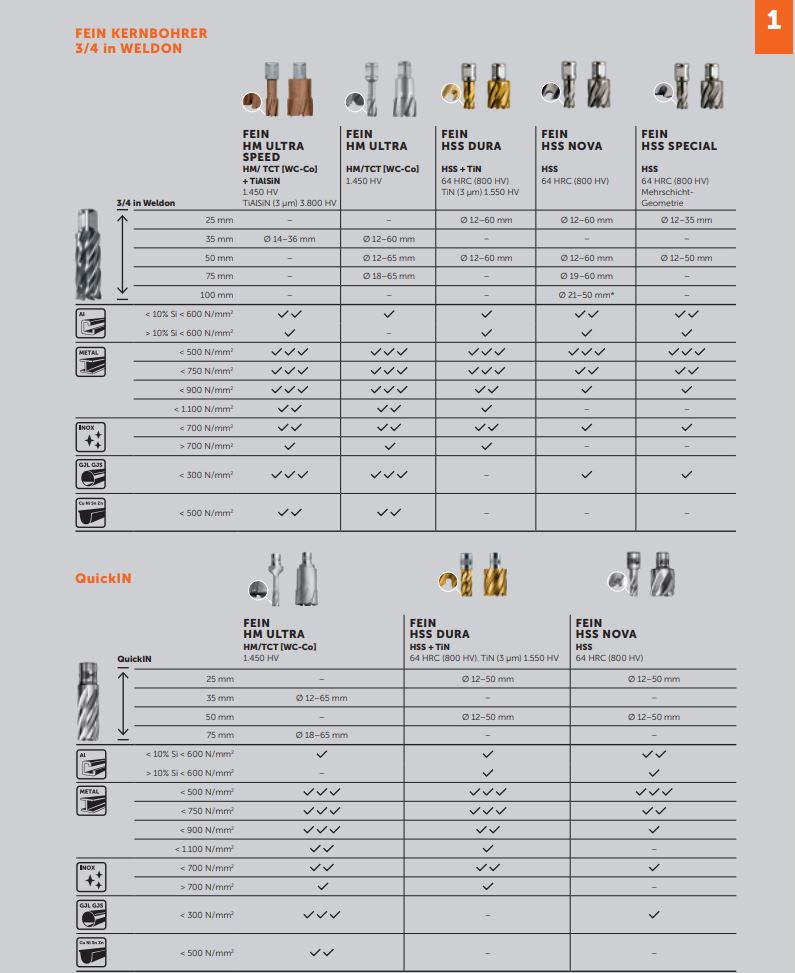
Selection of the correct core drill according to the material to be drilled.
- Risk: Core drill is not suitable for the material to be drilled.
Handle core drills with care. Transport and storage should only take place in the packaging intended for this purpose. Do not bump the drill bit anywhere.
- Risk: Cutting edges can break out.
The material to be drilled should not be thinner than 12 mm.
- Risk: Magnetic holding force not guaranteed. Machine moves, vibrates, wobbles and shifts on the material to be drilled.
The surface on which the machine is placed should be even, clean and free of scale.
- Risk: Magnetic holding force not guaranteed. Machine shifts on the material to be drilled. Cutting edges break out or the drill bit tears at the shank.
The magnetic base must be seated over the entire surface of the material to be drilled.
- Risk: Magnetic holding force not guaranteed. Machine is displaced on the material to be drilled. Cutting edges break out or the drill bit tears at the shank.
The dovetail guides on the machine should be set without play.
- Too much play in the dovetail guide means that the core drill has poor concentricity and is loaded on one side
-> Cutting edges break out or the drill breaks at the shank.
Always work with the centering pin.
- Risk: Drill core is not ejected. Use of internal coolant supply is not possible.
When drilling, always ensure good cooling, if possible with drilling emulsion. Cooling should always take place via the lubrication device provided with the machine (internal cooling of the drill bit).
- Risk: Cutting edges overheat, become blunt and break out.
Position the drill bit carefully when starting to drill and, if possible, drill through in one go.
- Risk: Core drill rattles on the material to be drilled. Cutting edges break out or the drill bit tears at the shank.
Do not switch off the machine during the drilling process.
- Risk: Cutting edges can break out.
If possible, do not drill overlapping holes.
- Risk: Cutting edges can break out as they hook into the first hole. When engaging, the cutting edges always receive a slight impact.
Do not drill near weld seams or cutting edges of cutting torches.
- Risk: The high temperatures can lead to structural changes. This can cause core drills to wear very quickly.
Medien: